Punjabi matrimony in Australia
Punjabi is the fifth most spoken language in Australia after English, and the fastest growing, up four fifths in five years. Punjabi families here are the biggest single group looking for a rishta, and the least well served by sites built for India. This page is for them, Sikh and Hindu alike.
Open in Australia today. Every profile is ID-checked before anyone can see it. Page updated .
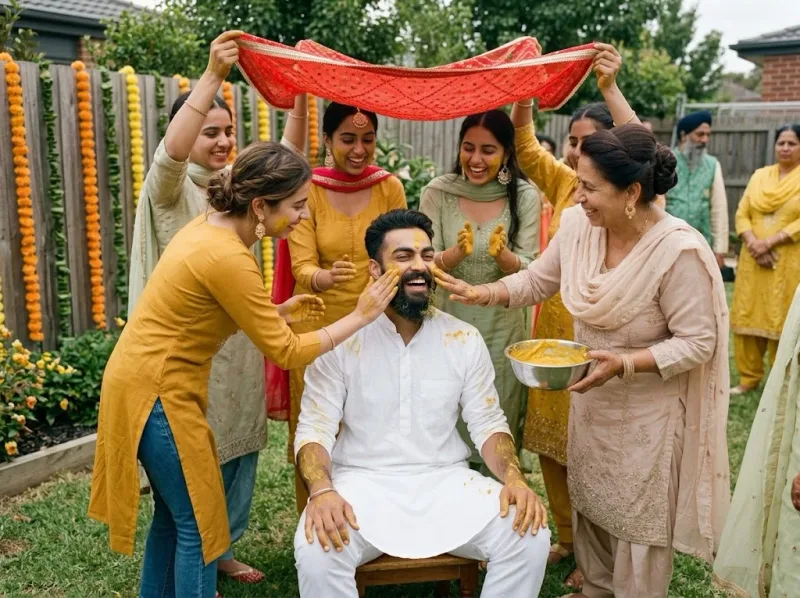
From the banana farms to the fifth language in the country
Punjabis have been in Australia far longer than the community’s size suggests. Sikh hawkers walked the country roads of Victoria and New South Wales in the 1890s; in the Second World War Sikh families moved to the banana farms around Woolgoolga on the New South Wales north coast, bought land in the 1950s and 1960s, and opened the first gurdwara in Australia there in 1968, when the town counted six Sikh women. The White Australia years kept the community tiny; the Racial Discrimination Act of 1975 opened the door, and the skilled migration of the last twenty years turned a trickle into the fastest-growing language in the country.
The 2021 Census counted 239,033 people speaking Punjabi at home, up 80% on 2016, which made Punjabi the fifth most spoken language in Australia after English, behind only Mandarin, Arabic, Vietnamese and Cantonese. Most of them are Sikh, and most of the rest are Hindu Punjabis from the same districts and often the same families.
Where they are: Melbourne first, by a distance, in the northern corridor from Craigieburn to Wollert and the western one from Tarneit and Truganina out to Point Cook, with the south-east around Cranbourne, Officer and Pakenham growing fastest; then Sydney’s north-west, Glenwood, Blacktown, Schofields and Quakers Hill, with the Harris Park strip where the wider Punjabi community meets; then Brisbane’s southside, Perth’s Canning Vale, Adelaide’s northern suburbs, and the regional towns, Shepparton, Griffith, Woolgoolga, Mildura, where Punjabi farming families have been for generations.
What a Punjabi family asks first
Sit at a Punjabi kitchen table in Tarneit or Glenwood when a biodata arrives and the order of questions is fixed. Pind and got come first, for the families that care; for the families that do not, they are never mentioned, and Rishta lets both be true by making community a field you can fill, filter on, make a must-have, or leave as no preference, with the choice invisible to everyone else. Then Sikh or Hindu, which the big sites blur into one box; here religion, community and mother tongue are three separate answers, so a Hindu Khatri family and a Sikh Jat one are each described exactly, and Punjabi is the mother tongue on both. Then kesh, which every Sikh man’s profile answers before a word is exchanged, along with Amritdhari and how practising for every Sikh member. Then, asked quietly but asked first, whether the person has PR: on Rishta it is a field, citizen, permanent resident or which visa, and a filter. Then vegetarian or not, a field too. And then the Australian question that Ludhiana never had to ask: which city, since Perth is four hours’ flight from Melbourne, which is why profiles say whether someone would move and a search can run over one city, one state, the country, or both countries.
What a Punjabi family does not want
To be looked at. Punjabi Australia is a quarter of a million people and, for the purposes of gossip, one village: a daughter’s photo on an open matrimonial gallery is recognised at the Craigieburn gurdwara the following Sunday, which is why she refuses to put it there and why her mother ends up asking around at langar instead. Rishta has no gallery to be looked at in. A woman’s photo reaches the one man she has approved, and only then do the two see each other; she decides whether she can be found by every approved man, by the men who fit her preferences, or by no one but her matchmaker; no profile ever shows a phone number or an email; and nobody is visible until an ID check has passed and our quality team has read the profile, so the man writing from Truganina is the man in the photo.
From interest to roka
Every interest here is a short letter, not a tap, so none can be sent by the hundred; when she accepts, the photos open both ways and the two can write and call inside Rishta without a number changing hands. The rest is the families’ work, and our guides are written for how it is done from here: the roka between Melbourne and Punjab, the Anand Karaj at an Australian gurdwara, the Prospective Marriage visa when the match is in India, and registering the marriage so that the lavaan are also the law. Families who would rather a professional did the looking can use a matchmaker, paid for by whoever uses it, women and men alike, and never from their own city.
Punjabi, across both countries
The Sikh page for Australia goes deeper on the gurdwaras and the Sikh-specific fields; the Melbourne and Sydney pages are suburb by suburb; and the Punjabi page for New Zealand is the same site from the other side of the Tasman.
Questions before you join
Hindu Punjabi families: is this page for us too?
Can the search be limited to our own community?
The family is in Punjab and wants to run this.
Kesh: is it on the profile or do we have to ask?
Is Auckland in the same search?
What is the cost?
Also in Australia
- Indian matrimony in Australia
- Sikh matrimony in Australia
- Hindu matrimony in Australia
- Gujarati matrimony in Australia
- Tamil matrimony in Australia
- Telugu matrimony in Australia
- Malayali matrimony in Australia
- Muslim matrimony in Australia
- Indian Christian matrimony in Australia
- Fiji Indian matrimony in Australia
- Marathi matrimony in Australia
- Bengali matrimony in Australia
- NRI matrimony in Australia
Join Rishta in Australia
Join now and it’s free until 31 December 2026. After that, Search is $39 a month or $99 for 3 months, the same for women and men.