Gujarati matrimony in Australia
Gujaratis in Australia are a community of shopkeepers, accountants, pharmacists and engineers whose temples are the busiest in the country and whose rishtas are still, more often than not, arranged. This page is for Gujarati families looking from here, whether the family arrived from Ahmedabad last year or from Nairobi or Suva a generation ago.
Open in Australia today. Every profile is ID-checked before anyone can see it. Page updated .
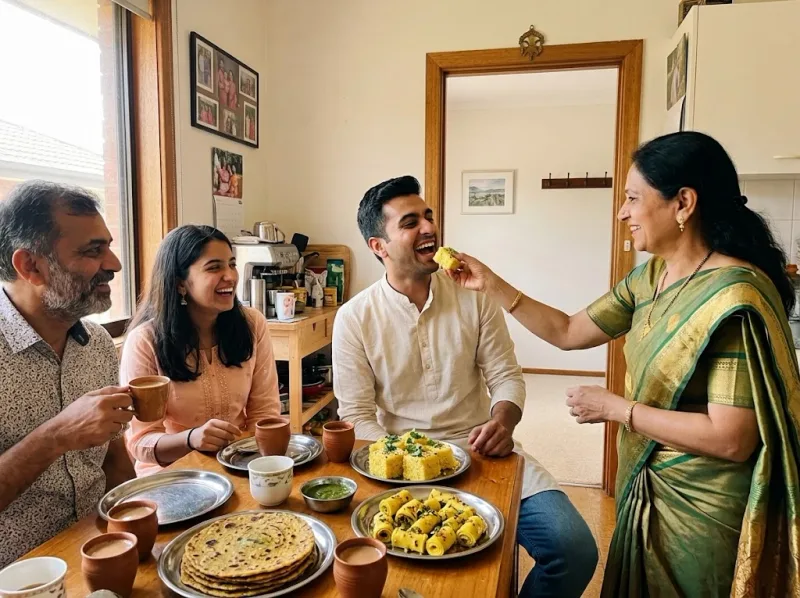
Who the Gujarati community in Australia is
Gujaratis came to Australia in two quite different ways. A first community of traders and professionals arrived from the 1970s, many of them by way of East Africa, Fiji and Britain, settled in Sydney and Melbourne, opened pharmacies, newsagencies and accountancy practices, and built the mandirs. A second and much larger wave came on skilled and student visas from the 2000s, from Ahmedabad, Surat, Vadodara and Rajkot, and settled where the newer suburbs are. The 2011 Census already counted more than 50,000 Gujarati speakers at home, and the community has grown sharply since.
Where it lives: western Sydney, from Harris Park and Parramatta out to Blacktown and the Hills; Melbourne’s west and south-east; Brisbane’s southside; and Perth, Adelaide and Canberra in smaller numbers. The BAPS Swaminarayan mandirs in Sydney and Melbourne are the community’s landmarks, and Navratri, nine nights of garba in halls across both cities, is the event of the year, and the one where more rishtas have begun than at any website.
Two Gujarati communities, one search
A matrimonial site built for India assumes everyone is the second kind. Families of the first kind find themselves answering questions about villages they have not visited in fifty years. Families of the second kind find themselves matched with people in Gujarat when they were hoping for someone in Parramatta.
Rishta keeps the two apart by asking plainly. Is the person a citizen, a permanent resident, or on which visa? Where is the family from, in your own words, so that Kampala or Suva or Leicester is part of the story rather than lost under India? Which language at home, Gujarati, English or another? Vegetarian, Jain, or not, which for many Gujarati households is question one? Which community, Patel, Lohana, Brahmin, Jain, Vaniya or another, for the families who ask, and no preference for the families who do not, with nobody else shown the answer? Each of those can be a must-have, so a third-generation family and a newly arrived one can each search for its own kind, or deliberately not.
What neither family wants asked in public stays private. No gallery; a photo reaches one approved man at a time; no phone number or email on any profile; and nobody visible until an ID check, document and live selfie, has passed and a person on our quality team has read the profile.
What a Gujarati family looks for, and what the site can carry
The conversation in a Gujarati household is about the family as much as the person: what the parents do, where the family is from, whether the home is vegetarian, how the festivals are kept. Rishta’s profile has the family section for exactly that, the About section in your own words, and a Family View page a member can share with relatives who are not members, so the aunties in Surat can read a profile without anyone handing over a phone number.
An interest always carries a personal message, so none can be sent in bulk. If she accepts, both see each other’s photos and can message and call inside the site. A parent can make and manage the profile; the person on it confirms their own identity before it goes live; and a matchmaker can speak to the family with the member’s consent.
The wedding, and the paperwork
Registering a marriage in Australia explains the Notice of Intended Marriage, the month’s wait and how a mandir ceremony becomes the legal marriage. If the match is in Gujarat, the Prospective Marriage visa is the visa Home Affairs built for a couple who have met and intend to marry here.
The Hindu page for Australia covers the temples and the Hindu-specific fields, the Sydney and Melbourne pages go suburb by suburb, and the Gujarati page for New Zealand is the other side of the Tasman. Joining is free until 31 December 2026 for everyone who joins now.
Questions before you join
Strictly vegetarian households: can we filter?
Patel, Lohana, Brahmin, Jain: can we search our own community?
Which language is spoken at home: is that on the profile?
We came by way of Nairobi, or Fiji, or Durban.
Can the search include Auckland?
What does it cost?
Also in Australia
- Indian matrimony in Australia
- Punjabi matrimony in Australia
- Sikh matrimony in Australia
- Hindu matrimony in Australia
- Tamil matrimony in Australia
- Telugu matrimony in Australia
- Malayali matrimony in Australia
- Muslim matrimony in Australia
- Indian Christian matrimony in Australia
- Fiji Indian matrimony in Australia
- Marathi matrimony in Australia
- Bengali matrimony in Australia
- NRI matrimony in Australia
Join Rishta in Australia
Join now and it’s free until 31 December 2026. After that, Search is $39 a month or $99 for 3 months, the same for women and men.