Bengali matrimony in Australia
More than seventy thousand people in Australia speak Bengali at home, but only about one in ten of them was born in India, so a family from Kolkata, Howrah or Siliguri looking for a Bengali rishta here is searching a small community inside a larger one. This page is about doing that honestly: which Bengalis, where they gather, and how a search here is built to tell them apart.
Open in Australia today. Every profile is ID-checked before anyone can see it. Page updated .
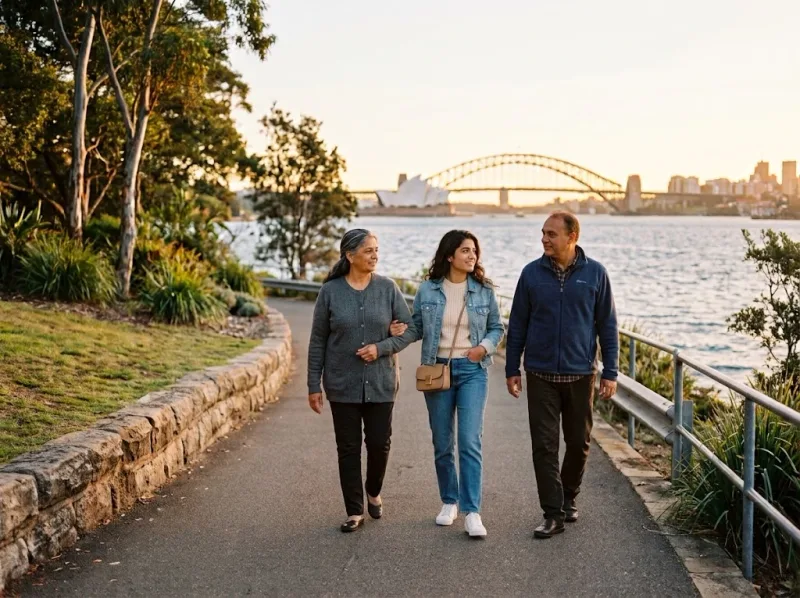
Bengalis in Australia, and which Bengalis
The 2021 Census counted 70,116 people who speak Bengali at home, up from 54,565 five years earlier. Two-thirds of them were born in Bangladesh, a fifth were born in Australia, and 7,507, roughly one in ten, were born in India. So the community a family from West Bengal is actually searching is a small one, perhaps fifteen thousand people including the children born here, and it is spread thin: Sydney first, then Melbourne, then Brisbane, Canberra, Perth and Adelaide in smaller numbers.
It is also an old community for its size. The Bengali Association of New South Wales was started in 1974 by twelve families, and its Durga Puja, usually at Concord High School, is the oldest in the country; in a good year Sydney has half a dozen pujas across the city. Melbourne’s Bengali Association dates from 1984, and since 2004 new pujas have opened across the city’s west, from Wyndham Vale to West Melbourne, as the newer families settled there. The people in it are, disproportionately, the people Kolkata exports: academics and researchers, doctors, IT engineers and accountants, from Kolkata and Howrah, from Durgapur, Siliguri and Kharagpur, and the Bengali families of Delhi, Mumbai, Bengaluru, Guwahati and Agartala who have never lived in Bengal at all.
One word, three communities
“Bengali matrimony” on the sites built in India means Kolkata. Their Australia pages hold a scatter of profiles, most of them in Salt Lake or Garia with Australia ticked as a possibility, and the word Bengali does three jobs at once: a Hindu family from Howrah, a Muslim family from Sylhet and a Christian family from Barrackpore are one box. For a family here that is useless twice over. It cannot find the people it means, and it is found by the people it does not.
On Rishta the three things are three fields. Religion is one: Hindu, Muslim, Christian, Buddhist, with the Bengali communities under each where they exist, Bengali Brahmin, Bengali Kayastha, Baidya and Mahishya under Hindu and Bengali Muslim under Muslim. Mother tongue is another, Bengali whichever side of the border the family came from. Family origin is the third: India, then the state, West Bengal or Assam and the North East, then the native place in your own words; or Other, with the place written in. Each is a filter. A family that wants a Hindu Bengali match from West Bengal sets three filters and gets what it set.
What a Bengali rishta asks
The questions a Bengali family asks first are not the ones a Punjabi or Gujarati family asks, and the form does not pretend they are. Ghoti or bangal, which side of the old border the family came from, goes in the About section in your own words, where it belongs. Community is there for the families who use it and absent for those who do not. Diet is asked plainly, from vegetarian through occasionally non-vegetarian to non-vegetarian, which for a community that eats fish on a Tuesday matters more than most sites allow. Education and work are written out rather than reduced to a one-word title, because a Bengali family will want to know which department and which university. Residency status, citizen, permanent resident or which visa, is on every profile, which for the many who came as research students and postdocs is the question that decides the rest.
What is not asked is the kosthi. We do not match horoscopes, and we would rather say so than pretend to; a family that wants one read arranges it once two profiles are talking.
A thin pool, searched widely
Fifteen thousand people is a few hundred unmarried Bengalis of any age in the whole country, and most of them are not in your suburb. A search on Rishta can take in Australia and New Zealand together, and open to living in is a field on every profile, so the physicist in Canberra who would move to Sydney is found from Sydney. For families open to a match from Bengal who would move here, Open to a partner who lives overseas is a switch on your profile: off, you see only people in the two countries; on, you also see members in India who have said they would move to Australia to marry, with the city and the family they already have here on their card.
When even that is thin, a Personal Matchmaker, $1,199 for three months, reads the file, searches on your behalf and can talk to both families by invitation. An Icebreaker, one arranged call for $29, is the smaller step for a family that has found someone and wants an introduction made properly.
Photos, in a community where every puja committee knows every family
A Bengali woman in Sydney who puts her photograph on a public matrimonial gallery can expect the puja committee to know by the next Saturday. The community is small, educated and talkative, and that is why Bengali women barely appear on the India-built sites and why so many searches are run entirely from Kolkata by the parents.
On Rishta nothing is public. There is no gallery and no profile that a search engine can reach. Her photo is shown to one man after she has approved him, and then the two see each other’s. Being findable at all is her setting: every approved man, only the men who fit her preferences, or nobody but her matchmaker. No profile carries a phone number or an email address, so nothing can be passed around. An interest cannot be sent without a written message. And nobody appears in anyone’s search until a passport or licence and a live selfie have been checked and a person on our quality team has read the profile.
Family, and the wedding after
A Bengali rishta is still, for most families, two families talking, and the site is built for that rather than around it. A parent can make and manage the profile, and the profile says so. Relatives who are not members can be shown a Family View page. A matchmaker speaks to both families with the member’s consent. When the families agree, registering a marriage in Australia explains the notice, the month’s wait and how a ceremony with the purohit becomes the legal marriage here. If the match is in Bengal, the Prospective Marriage visa is the route for a couple who have met in person and intend to marry here, and the meeting should be planned before the ashirbad, not after.
The Hindu page for Australia covers the temples and the Hindu-specific fields, the Sydney and Melbourne pages go suburb by suburb, and the NRI page is for families in India looking this way. Joining is free until 31 December 2026 for everyone who joins now.
Questions before you join
Brahmin, Kayastha, Baidya, Mahishya: can we filter by community?
Does the site tell a family from West Bengal apart from one from Bangladesh?
We eat fish. Does diet matter here?
Do you match kosthis?
Can my parents in Kolkata manage the profile?
What does it cost?
Also in Australia
- Indian matrimony in Australia
- Punjabi matrimony in Australia
- Sikh matrimony in Australia
- Hindu matrimony in Australia
- Gujarati matrimony in Australia
- Tamil matrimony in Australia
- Telugu matrimony in Australia
- Malayali matrimony in Australia
- Muslim matrimony in Australia
- Indian Christian matrimony in Australia
- Fiji Indian matrimony in Australia
- Marathi matrimony in Australia
- NRI matrimony in Australia
Join Rishta in Australia
Join now and it’s free until 31 December 2026. After that, Search is $39 a month or $99 for 3 months, the same for women and men.