Marathi matrimony in Australia
Maharashtrians are one of the smaller Indian communities in Australia, and for a rishta that is the whole difficulty: the sites built in Pune send you profiles in Pune, and the pool in your own city is a few hundred families who mostly know each other. This page is about searching from Melbourne, Sydney or Brisbane, in Marathi terms, across the whole country.
Open in Australia today. Every profile is ID-checked before anyone can see it. Page updated .
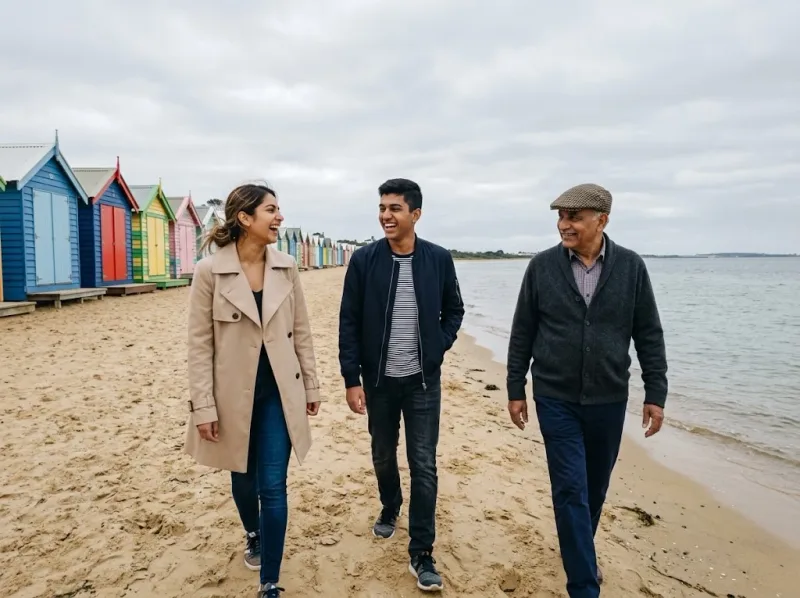
Maharashtrians in Australia
About 22,000 people spoke Marathi at home at the 2021 Census (the Australian Bureau of Statistics counted 22,080), up from roughly 13,000 a decade earlier. In New South Wales alone the community grew by two-thirds in the five years to 2021, to 9,753 people, nearly half of them in western Sydney. Victoria has the older community: the Maharashtra Mandal of Victoria was formed in 1981 by the first thirty or forty families from the state, and it still runs the Marathi calendar in Melbourne. Sydney’s Marathi Association started the Australian Marathi Vidyalaya in 2008 with a dozen pupils; it now teaches about 150 children at four centres across Sydney and Wollongong. Every third year the All Australia Marathi Sammelan brings the whole country together, in Melbourne in 2022 and in Sydney in April 2025.
It is a community of engineers, IT people, pharmacists, accountants and academics, from Pune and Mumbai above all, then Nagpur, Nashik, Kolhapur and Aurangabad, with a newer wave of students and graduates. The year turns on Gudi Padwa, Maharashtra Day on the first of May, Ganeshotsav (one Sydney Ganeshotsav marked its thirtieth year in 2025), Kojagiri and Diwali. And it is small enough that a family looking for a rishta in Melbourne knows, roughly, every other Marathi family with a son or daughter of the right age.
Why a Pune site does not work from Parramatta
Search for Marathi matrimony from Australia and what you find are sites built for Maharashtra. Their Australia page holds a few dozen profiles, most of them students or people in Pune who have ticked Australia as a country they might consider. Their questions are Pune’s questions, asked well: kul, gotra, the patrika, the sub-caste. What they cannot tell you is the one thing a Marathi family here needs to know first, which is whether the person is actually in Australia to stay, and on what footing.
So the search falls back on the Mandal, the Ganeshotsav committee and the family in Pune, which works until the community runs out of unmarried engineers of the right age, which in a community of twenty thousand happens quickly.
The profile, in Marathi terms
On Rishta the fields are the ones a Maharashtrian family actually uses, and each is a filter:
- Mother tongue: Marathi, and Konkani for families from the coast.
- Family origin: India, then the state, Maharashtra or Goa, then the native place in your own words: Pune, Dombivli, Sangli, Ratnagiri.
- Community, for the families who use it: Maratha, Deshastha Brahmin, Kokanastha Brahmin, Saraswat Brahmin (GSB), CKP, Kunbi, Mali, Teli, Agri, Vanjari, with no preference for the families who do not. Choose Maharashtra as the state and these are shown first.
- Religion, separately: Hindu, Jain (Digambar or Shwetambar), Buddhist with Ambedkarite / Navayana on the list, Christian with East Indian Catholic, Muslim with Deccani.
- Residency status: citizen, permanent resident, or which visa, which answers the Parramatta question before anyone writes.
- Diet, from vegetarian to non-vegetarian, with the shades in between.
- Open to living in: because the one Deshastha pharmacist you want to meet may be in Brisbane.
What is not on the form: a horoscope. We do not match kundalis or flag mangal doshas, and we will not pretend to; families who want a patrika compared do it themselves once two profiles are talking.
A small community needs a wide search
The practical problem for Marathi families here is the arithmetic. Twenty-two thousand speakers, spread over six cities and two coasts, is a few hundred unmarried people of any given age, and a city-only search with three filters on it can come back with nobody. Three things on Rishta are built for exactly this. A search can cover Australia and New Zealand together, as one pool. Open to living in is a field on every profile, so the person who would move to Melbourne is found from Melbourne. And Open to a partner who lives overseas is a switch: off, you see only people here; on, you also see members in Maharashtra who have said they would move to Australia to marry, with the city and the family they already have here written on their card.
If the filters still come back thin, a Personal Matchmaker, $1,199 for three months, reads the whole file, searches on your behalf, approaches people and can speak with both families by invitation. An Icebreaker, one arranged call for $29, is the smaller step.
Private, in a community of a few hundred families
A Maharashtrian woman in Melbourne who puts a photograph on a public matrimonial gallery can assume it reaches the Mandal’s committee by the weekend. That, more than anything, is why Marathi women are so thinly present on the sites built in India, and why so many searches here are run entirely by the parents.
On Rishta there is no gallery and no profile page that Google can find. Her photo is shown to a man only after she has approved him, and then the two see each other. Whether she can be found at all is her setting: every approved man, only the men who meet her preferences, or nobody but her matchmaker. Profiles carry no phone number and no email, so nothing can be forwarded to a WhatsApp group. An interest cannot be sent without a written message. And every person on the site has had a passport or licence and a live selfie checked, and the profile read by a person on our quality team, before anyone can see them.
Families, and what comes after
Most Marathi rishtas are still arranged by two families, and the site is built for that. A parent can make and manage the profile, and the profile says so; relatives who have not joined can be shown a Family View page; a matchmaker speaks to both families with the member’s consent. When the families agree, registering a marriage in Australia explains the notice, the month’s wait and how the ceremony at the Mandal’s hall or a temple becomes the legal marriage. If the match is in Maharashtra, the Prospective Marriage visa is the route for a couple who have met in person and intend to marry here, and the meeting should be planned before the engagement, not after.
The Hindu page for Australia covers the temples and the Hindu-specific fields, the Melbourne and Sydney pages go suburb by suburb, and the NRI page is for families in India looking this way. Joining is free until 31 December 2026 for everyone who joins now.
Questions before you join
Maratha, Deshastha, Kokanastha, CKP: can we keep the search to our own community?
We are Marathi, but Buddhist. Does the site understand that?
Do you match patrikas?
Can my parents in Pune be part of it?
The community here is small. What if nobody matches?
What does it cost?
Also in Australia
- Indian matrimony in Australia
- Punjabi matrimony in Australia
- Sikh matrimony in Australia
- Hindu matrimony in Australia
- Gujarati matrimony in Australia
- Tamil matrimony in Australia
- Telugu matrimony in Australia
- Malayali matrimony in Australia
- Muslim matrimony in Australia
- Indian Christian matrimony in Australia
- Fiji Indian matrimony in Australia
- Bengali matrimony in Australia
- NRI matrimony in Australia
Join Rishta in Australia
Join now and it’s free until 31 December 2026. After that, Search is $39 a month or $99 for 3 months, the same for women and men.