Indian matrimony in Sydney
New South Wales has more people of Indian ancestry than any other state, and nearly all of them are in Sydney, from the Harris Park strip that the whole community calls Little India to the new estates past Schofields. It is a city where every Indian community is large enough to have its own temple, and small enough that everyone still knows someone who knows you.
Open in Sydney today. Every profile is ID-checked before anyone can see it. Page updated .
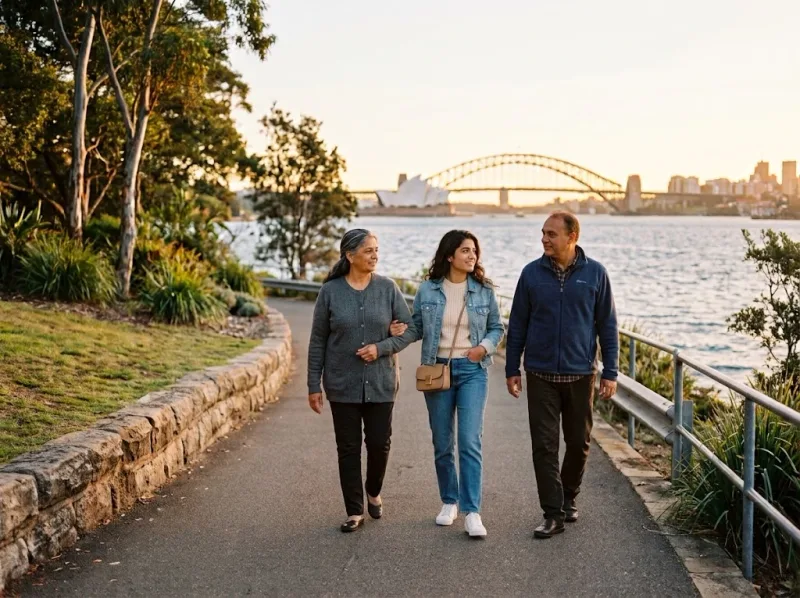
The biggest Indian city in Australia
New South Wales counted 350,770 people of Indian ancestry at the 2021 Census, 273,780 Hindus and 47,165 Sikhs, and Sydney holds nearly all of them. It is also the oldest Indian city in the country: the Sri Mandir at Auburn, opened in 1977, was Australia’s first Hindu temple, and the Anglo-Indian and Goan communities of the inner west go back further still.
Parramatta and Harris Park are the centre of it all, the strip of restaurants, jewellers and sari shops where every community meets, with Westmead, Wentworthville, Pendle Hill, Toongabbie and Girraween around it, the Tamil heartland and the Telugu one too. The north-west, Blacktown, Glenwood, Quakers Hill, Schofields, Riverstone and the new estates towards Marsden Park, is Sikh and Punjabi Sydney, with the Glenwood and Parklea gurdwaras at its heart. The Hills, Kellyville, Bella Vista and Rouse Hill, is where the professional families of every community have moved as they could, and where the Swaminarayan mandir and the newer temples are. The south-west, Liverpool, Rooty Hill, Mount Druitt and out to Austral, is the heart of Fiji Indian Australia, with a gurdwara at Austral and another at Revesby. The great temples sit on the edges: the Sri Venkateswara Temple at Helensburgh on the southern coast, the Murugan temple at Mays Hill, the Durga temple at Regents Park. The mosques of Lakemba, Auburn and Granville serve the South Asian Muslim community alongside everyone else.
Parramatta’s Diwali fair is the largest in the state, and the Australian Sikh Games, when Sydney hosts them, fill the north-west for a weekend.
Why privacy is the Sydney problem
In a city with this many Indian families, a photo on a public matrimonial gallery is seen by someone you know within days, at the mandir, the gurdwara, the office in Parramatta or the Harris Park strip on a Saturday night. That is why women in Sydney are so thinly represented on the India-built sites, and why their mothers end up asking around instead, which is not private either.
So Rishta has nothing for the Harris Park grapevine to find. A woman’s photo goes to one man she has approved, and then the two photos open both ways. She alone decides whether she can be found by every approved man, by the men who fit what she asked for, or by nobody except her matchmaker, and the setting is private. Phone numbers and emails are never printed on a profile. And a profile does not exist, as far as anyone else is concerned, until an ID document and a live selfie have been checked and a person on our quality team has read it.
Every community, one search
Sydney is the one Australian city where every Indian community is large: Punjabi and Sikh in the north-west, Hindi-speaking and Gujarati families from Harris Park to the Hills, Tamil and Telugu around Westmead and Wentworthville, Malayali nurses and engineers everywhere there is a hospital, Fiji Indian families in the south-west, Goan and Anglo-Indian families in the inner west, and South Asian Muslim families from Granville to Lakemba. Each has its own page for Australia: Punjabi, Sikh, Hindu, Gujarati, Tamil, Telugu, Malayali, Muslim, Christian and Fiji Indian. The search underneath is the same: religion, community, mother tongue, diet, family origin and residency status are fields on every profile and filters in every search, and any of them can be a must-have.
Sydney’s particular question
More of the people looking in Sydney are on temporary visas than anywhere else in the country: students at the universities, graduates on their first work visa, skilled workers waiting on residence. Both families want it known early. Residency status is on every profile and in every search, and so is whether someone is open to living in another city, which for a family split between Sydney and Melbourne, or Sydney and Auckland, is often the deciding question.
What a Sydney search looks like in practice
Pick Sydney and a radius: the north-west alone, the whole basin, or out to Wollongong. Turn on the filters that matter and make the non-negotiable ones must-haves, which removes everyone who fails them before you see them. The rest is ordered by how complete a profile is and how recently its owner was here, and all of it has passed the ID check. An interest goes with a message you wrote or it does not go. When she accepts, you see each other’s photos and talk and call inside Rishta.
Joining is free until 31 December 2026 for everyone who joins now. If you would like help, a matchmaker is available to women and men alike, as a separate paid service, and never from your own city. The Melbourne, Brisbane and Perth pages are the other cities, and a search can take in all of them.
Questions before you join
Can I keep the search to Sydney?
Does the profile give away my suburb?
Which communities are covered?
The family is in India and wants a say.
Where do people meet?
What does it cost?
Indian matrimony across Australia
Join Rishta in Sydney
Join now and it’s free until 31 December 2026. After that, Search is $39 a month or $99 for 3 months, the same for women and men.